Car Overheating in Elkins, WV? Do This Right Away
You are climbing the grade on US-33 out of Elkins, the summer sun is beating down, and the temperature needle starts creeping toward the red. Maybe you catch a whiff of hot coolant, or a wisp of steam curls up from under the hood. Your stomach drops. An overheating engine is one of the most common ways a good day on the road in Randolph County goes sideways — and one of the easiest to make far worse if you panic and do the wrong thing.
The good news is that the first few minutes are almost entirely within your control. Handle them correctly and you often walk away with a simple repair. Handle them wrong and you can warp a cylinder head or blow a head gasket before you have gone another mile. This guide walks you through exactly what to do the moment your car starts to overheat near Elkins, what to avoid, and how to know when it is time to shut it down and call for a tow.
Why Cars Overheat on the Roads Around Elkins
Overheating simply means your engine is making more heat than the cooling system can carry away. The cooling system is a loop — coolant absorbs heat from the engine, the water pump pushes it to the radiator, air flowing through the radiator sheds that heat, and the thermostat regulates the whole cycle. When any part of that loop fails, temperature climbs fast.
Around here, a few situations make it more likely. Long mountain climbs on US-33 (Corridor H), US-219, and US-250 put a sustained load on the engine, and pulling a grade in July is when a marginal cooling system finally gives up. Stop-and-go traffic through downtown Elkins on a hot afternoon reduces the airflow that normally cools the radiator. And towing a trailer or hauling a full load up toward Huttonsville or Beverly adds heat the system may not be sized for.
The usual mechanical culprits are a low coolant level from a slow leak, a failing water pump, a stuck thermostat, a split radiator hose, or a radiator fan that has quit. Any one of them can turn a normal drive into a roadside stop in minutes. You do not need to diagnose which one it is on the shoulder — you just need to protect the engine.
What To Do the Moment Your Temperature Gauge Climbs
Speed matters here, but so does staying calm. Work through these steps in order:
- Turn off the air conditioning and turn the heat on full blast. It feels backwards on a hot day, but the heater core acts like a second radiator and pulls real heat out of the engine. Roll the windows down and tough it out for a minute.
- Ease off the accelerator. If you are climbing a grade, back out of the throttle. Less load means less heat. If traffic allows, coasting or steady light throttle helps more than pushing hard.
- Find a safe place to pull over. On US-33 or US-219, get as far onto the shoulder as you safely can, ideally past a guardrail or in a pull-off. Put on your hazard lights so other drivers see you early on these fast, winding roads.
- Shut the engine off. Once the gauge is in the red or you see steam, the fastest way to stop the damage is to stop the engine. Sitting and idling will not cool a badly overheated engine quickly enough.
- Pop the hood latch, but wait. Release the interior hood latch so heat can start to escape, but do not raise the hood into a cloud of steam. Give it several minutes.
What NOT To Do When Your Engine Overheats
A few instincts make things dramatically worse. Avoid these:
- Do not open the radiator cap while the engine is hot. The cooling system is pressurized, and superheated coolant can erupt and cause serious burns. Wait until the engine has fully cooled — at least 30 to 45 minutes — before touching the cap.
- Do not pour cold water into a hot engine. A sudden temperature shock can crack the engine block or cylinder head. If you add coolant or water at all, do it slowly and only once things have cooled down.
- Do not keep driving to "just make it home." This is the single most expensive mistake. Nursing an overheated car the last few miles to Belington or Buckhannon can convert a minor fix into a full engine replacement.
- Do not ignore a gauge that keeps climbing after it briefly settled. If the temperature drops when you shut off, then spikes again the moment you drive, the problem is active and the car needs a tow, not another attempt.
The federal safety guidance is consistent on this point: if a vehicle is not safe to operate, the right move is to get it and its occupants off the roadway. The National Highway Traffic Safety Administration stresses keeping yourself out of live traffic and away from a disabled vehicle while you wait for help — sound advice on the fast stretches of Corridor H.
When an Overheated Car Needs a Tow in Randolph County
Not every temperature spike ends in a tow. If the gauge climbed because you were crawling in traffic, then dropped back to normal once you got moving with the heater on, you may simply have a marginal cooling system to get checked soon. But some signs mean the car should not be driven again until a shop has looked at it:
- Steam or the smell of sweet, hot coolant coming from under the hood.
- A puddle of green, orange, or pink fluid under the car after it sits.
- The temperature gauge returning to the red within a minute or two of restarting.
- A knocking, ticking, or rough-running engine after it overheated — a sign internal damage may already have started.
- A dashboard warning light for coolant temperature that stays on.
If any of those apply, calling for a tow is the cheap insurance play. We serve Elkins, Beverly, Huttonsville, Belington, Buckhannon, Philippi, Parsons, and Coalton, and we run 24/7, so it does not matter whether you are stranded at noon or midnight. Our typical response time across the area is 30 to 45 minutes, and we will give you an honest read on whether the car can roll or needs to come off the road entirely.
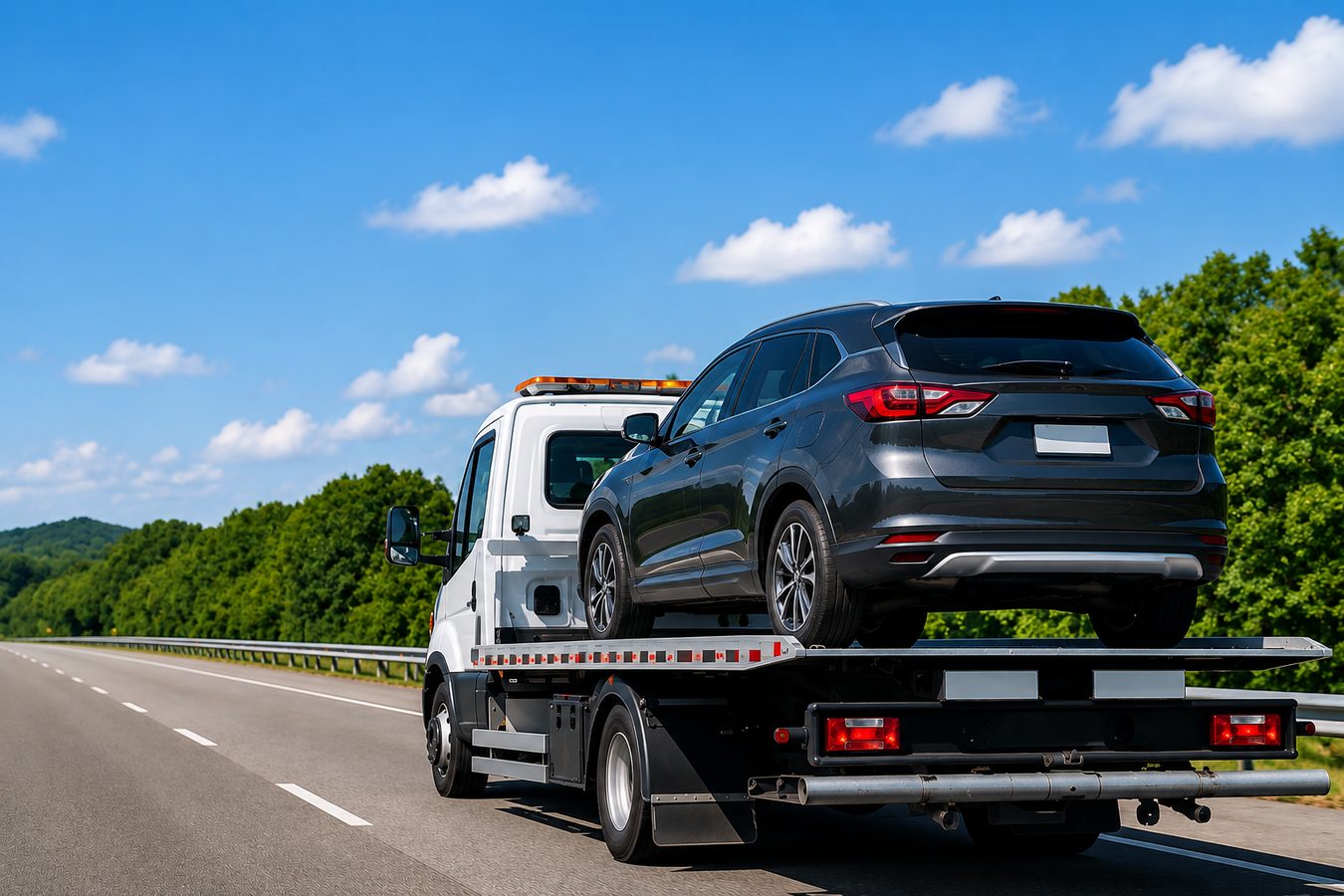
How Our Flatbed Towing Protects an Overheated Engine
When an engine has overheated, how it gets moved matters. A flatbed tow lifts the entire vehicle off the ground so the engine and drivetrain never turn during transport — no added heat, no forced circulation through a system that may already be compromised. For an overheated car, that is exactly what you want.
Our drivers are licensed, insured, and DOT compliant, and we run flatbed and wheel-lift trucks so we can match the right equipment to your vehicle, from a compact sedan to a loaded pickup. If you are wedged on a narrow shoulder on WV-92 or blocking a lane near the Tygart Valley River, we also handle the recovery and winch-out side safely so you are not standing in traffic trying to sort it out yourself. The goal is simple: get you and your car off the road, protect the engine from further damage, and get it to the shop you choose.
Overheated on the Side of the Road?
Do not risk your engine. Elkins Towing runs 24/7 flatbed and roadside recovery across Randolph County, with fast, upfront-priced tows.
Call (615) 241-0232 NowFrequently Asked Questions
Can I keep driving my car a short distance if it is overheating?
It is risky. A few minutes of driving on a badly overheated engine can warp the cylinder head or blow the head gasket, turning a cheap fix into a multi-thousand-dollar repair. If the temperature gauge is in the red or you see steam, pull over safely, shut the engine off, and call for a tow. A short tow across Elkins is far cheaper than a new engine.
How much does it cost to tow an overheated car in Elkins?
Most local overheating tows in and around Elkins fall into a standard local rate that covers the hook-up plus a set number of miles, with a small per-mile charge beyond that. Because we are licensed, insured, and DOT compliant, you get an upfront price before we roll. Call (615) 241-0232 for an exact quote for your location in Randolph County.
Have you ever had a car overheat on one of the mountain grades around Elkins — what did you do first?